
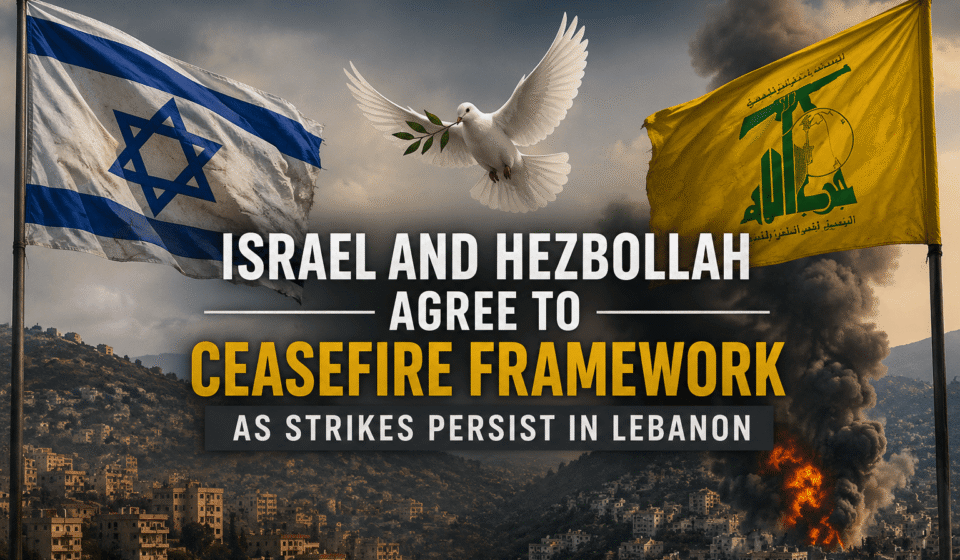
Israel and Hezbollah Agree to Ceasefire Framework as Strikes Persist in Lebanon

Israel and Hezbollah have reached a tentative agreement on a ceasefire framework aimed at halting more than a year of cross-border hostilities. However, the diplomatic milestone remains highly precarious as continued military strikes are reported across Lebanon, threatening to disrupt the fragile peace process before it fully takes hold. International mediators have urged both sides to exercise maximum restraint to prevent the complete collapse of the newly negotiated arrangement.
The conflict, which escalated significantly over recent months, has displaced hundreds of thousands of civilians on both sides of the border and caused widespread destruction. While the announcement of the Israel Hezbollah ceasefire has offered a glimmer of hope for regional stabilization, the reality on the ground highlights the immense challenges of enforcing a halt to deep-seated military operations.
Escalating Combat Accompanies the Israel Hezbollah Ceasefire Announcement
The announcement of the diplomatic breakthrough came directly alongside reports of renewed violence. Local authorities in Lebanon confirmed that several airstrikes struck targets in Beirut and southern parts of the country just hours after negotiators signaled a consensus. The Israeli military stated that these operations targeted specific command centers and weapons storage facilities belonging to the militant group.
Concurrently, sirens sounded across northern Israel as retaliatory rocket fire was detected crossing the border. Witnesses in southern Lebanon described intense artillery shelling, which sent residents fleeing for cover despite the widespread news of the impending truce. Diplomats close to the talks emphasized that a transitional period is often the most volatile, as both factions attempt to secure tactical advantages before the official implementation deadline.
Key Details and International Reactions to the Truce
According to officials familiar with the text of the agreement, the cessation of hostilities relies heavily on the enforcement of existing international mandates. A central pillar of the deal involves the withdrawal of Hezbollah forces north of the Litani River, alongside the deployment of Lebanese standard army troops to the southern border zone. Furthermore, the United Nations Interim Force in Lebanon (UNIFIL) is expected to receive an expanded role in monitoring compliance and reporting violations.
International reaction to the Israel Hezbollah ceasefire has been a mixture of relief and caution. Leaders from the United States and France, who played pivotal roles in brokering the diplomatic channel, issued a joint statement praising the resolution while demanding immediate adherence to its terms. Meanwhile, regional analysts warn that without a comprehensive political mechanism to address the root causes of the friction, any pause in fighting may only serve as a temporary intermission.
Background and Context of the Border Conflict
The current confrontation began the day after the October 7 attacks, when Hezbollah launched rockets into northern Israel in a show of solidarity with factions in the Gaza Strip. What commenced as low-level, intermittent skirmishes gradually transformed into a full-scale campaign involving targeted assassinations, extensive aerial bombardment, and ground incursions.
The border region between the two countries has long been a flashpoint. The last major conflict occurred in 2006, which concluded with UN Security Council Resolution 1701. Although that resolution successfully established a framework for peace, many of its core tenets—such as the disarmament of non-state armed groups in Lebanon—were never fully realized. This historical precedent has left many observers skeptical about the long-term durability of the current initiative.
What Happens Next for Regional Stability?
The immediate priority for international monitors is establishing a joint verification committee to oversee the withdrawal of combatants and verify the cessation of cross-border fire. In the coming weeks, the Lebanese government is expected to seek substantial financial and logistical assistance from global partners to fortify its military presence in the south.
Additionally, humanitarian organizations are preparing for the monumental task of facilitating the return of displaced populations to devastated border towns. If the truce holds, it could potentially create a diplomatic pathway toward addressing the broader regional crisis, including the ongoing conflict in Gaza. However, should either party violate the core terms of the agreement, a swift return to high-intensity warfare remains a distinct possibility.
- Joe Biden’s Cancer Has Spread Further, Hunter Biden Says
- Daylight Saving Time Explained: Why Clocks Change Every Year
- Trump Pushes for Daylight Saving Time as Clock Change Nears
- Spanish Enclave Ceuta Sees 60,000 Migrant Arrivals Within a Day
- FIFA Speeds Up 64-Team World Cup Plans Amid Gianni Infantino Sell-Off Proposal