
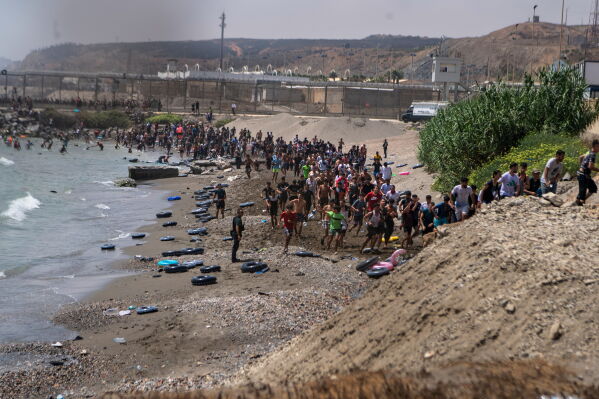

The Spanish enclave of Ceuta is facing an unprecedented migration challenge after reports indicated that approximately 60,000 migrants arrived within a 24-hour period. The sudden influx has prompted Spanish authorities to implement emergency measures as security forces and humanitarian organizations work to respond to the rapidly developing situation.
Located on the northern coast of Africa, Ceuta shares a land border with Morocco and has long served as one of Europe’s key entry points for migrants seeking to reach the European Union. The latest arrivals have placed immense pressure on local infrastructure, border security, and emergency services.
Ceuta Migrant Crisis Triggers Emergency Response
The Ceuta Migrant Crisis intensified as thousands of people reportedly crossed into the Spanish territory by scaling border fences, swimming around coastal barriers, or entering through other access points.
Spanish authorities quickly deployed additional police officers, Civil Guard personnel, and emergency responders to secure the border and assist those requiring medical attention.
Local officials declared emergency measures to help manage the growing number of arrivals while ensuring public safety and maintaining essential services throughout the enclave.
Humanitarian organizations also mobilized to provide food, temporary shelter, medical care, and other emergency assistance for migrants arriving in the territory.
Key Details and Official Reactions
Spanish government officials said they are closely monitoring the situation and coordinating with local authorities in Ceuta to manage the humanitarian and security challenges created by the sudden influx.
Additional border security personnel have reportedly been deployed to reinforce existing operations, while authorities continue processing new arrivals in accordance with Spanish and European Union immigration procedures.
Officials have also emphasized the importance of cooperation with Morocco to improve border management and reduce irregular migration.
Meanwhile, European Union leaders are expected to follow developments closely, as migration through Ceuta has broader implications for European border security and asylum policies.
Residents in Ceuta have expressed concern about the strain on local resources, while humanitarian groups have called for efforts to ensure migrants are treated safely and in accordance with international law.
Background and Context
The Ceuta Migrant Crisis is the latest chapter in a long-running migration challenge affecting Spain and the European Union.
Ceuta and the neighboring Spanish enclave of Melilla are the only European Union territories with land borders in mainland Africa. As a result, they have frequently become focal points for migrants attempting to enter Europe from North Africa.
Migration flows through the region often fluctuate due to political developments, economic conditions, regional conflicts, and cooperation between Spain and Morocco on border enforcement.
Previous migration surges have led to increased security measures, diplomatic negotiations, and humanitarian responses aimed at balancing border protection with the rights and safety of migrants.
The latest reported arrivals represent one of the largest single-day migration events ever recorded in Ceuta, significantly increasing pressure on local authorities.
What Happens Next?
Spanish authorities are expected to continue processing migrants while expanding emergency accommodation and humanitarian assistance where necessary.
The government may introduce additional border security measures and increase coordination with Moroccan authorities to prevent further large-scale crossings.
European Union officials are also likely to discuss the situation as part of broader efforts to strengthen migration management and support frontline member states facing increased migration pressures.
Investigations into the circumstances surrounding the mass arrivals are expected to continue, while humanitarian organizations remain focused on providing immediate assistance to vulnerable individuals.
The Bottom Line
The Ceuta Migrant Crisis has once again highlighted the complex challenges surrounding migration at Europe’s southern border. With reports of 60,000 migrant arrivals within a single day, Spanish authorities face the difficult task of balancing border security, humanitarian responsibilities, and public safety. As emergency operations continue, the developments in Ceuta are expected to influence wider discussions on migration policy and cooperation between Spain, Morocco, and the European Union.
- Joe Biden’s Cancer Has Spread Further, Hunter Biden Says
- Daylight Saving Time Explained: Why Clocks Change Every Year
- Trump Pushes for Daylight Saving Time as Clock Change Nears
- Spanish Enclave Ceuta Sees 60,000 Migrant Arrivals Within a Day
- FIFA Speeds Up 64-Team World Cup Plans Amid Gianni Infantino Sell-Off Proposal