
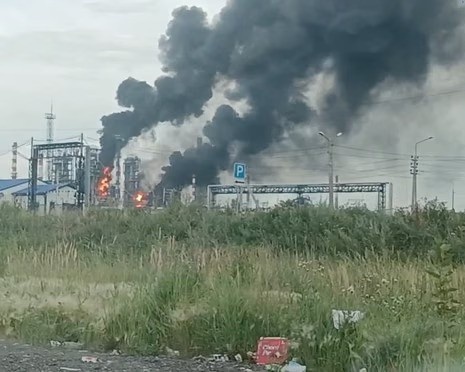
Ukrainian drones hit Russia’s largest oil refinery as Zelenskyy says Siberia now ‘within reach’

Ukraine has intensified its long-range campaign against Russian strategic infrastructure after Ukrainian drones hit Russia’s largest oil refinery, marking one of the most significant attacks on the country’s energy sector since the war began. The latest strike came as Ukrainian President Volodymyr Zelenskyy declared that even Siberia is now “within reach,” underscoring Kyiv’s expanding drone capabilities.
The reported attack targeted a major refining complex that plays a crucial role in Russia’s domestic fuel production and energy exports. While Russian authorities acknowledged drone activity in several regions, officials also moved to contain fires and assess damage at affected industrial facilities.
The incident highlights Ukraine’s growing focus on striking military and energy infrastructure deep inside Russian territory, a strategy aimed at disrupting logistics, fuel supplies, and wartime production.
Ukrainian drones hit Russia’s largest oil refinery in deep strike
The reported operation represents one of Ukraine’s deepest and most strategically important drone attacks against Russian energy infrastructure. According to Ukrainian officials, the long-range strike demonstrates that Kyiv’s domestically developed drone technology can now reach targets previously considered beyond operational range.
Although Russian authorities have not fully detailed the extent of the damage, local officials confirmed emergency services responded to fires at industrial facilities following the drone attack. Temporary restrictions were also imposed in parts of Russian airspace as air defense systems attempted to intercept incoming drones.
The refinery is considered one of Russia’s largest processing facilities, making it an important component of the country’s fuel supply network. Any prolonged disruption could affect the production of gasoline, diesel, aviation fuel, and other petroleum products that support both civilian consumption and military operations.
Ukraine has increasingly targeted refineries, fuel depots, ammunition warehouses, and military airfields throughout the conflict. Military analysts say these attacks are designed to increase the cost of Russia’s war effort while limiting its ability to sustain frontline operations.
Ukrainian drones hit Russia’s largest oil refinery as Zelenskyy signals expanded reach
President Volodymyr Zelenskyy used his latest remarks to emphasize the growing effectiveness of Ukraine’s domestic defense industry. Referring to recent long-range operations, he said that Siberia is now “within reach,” suggesting Ukrainian drone technology has evolved significantly despite ongoing battlefield challenges.
Ukrainian officials have repeatedly argued that attacks on energy and military infrastructure inside Russia are legitimate military objectives because they directly support Moscow’s invasion of Ukraine.
Russian authorities, meanwhile, condemned the strikes and reported that air defense systems intercepted numerous drones across multiple regions. Officials also pledged to strengthen protective measures around key industrial facilities.
The exchange reflects an increasingly important dimension of the conflict, with both countries relying heavily on drones for surveillance, precision strikes, and attacks against critical infrastructure far from the front lines.
Background and Context
Since 2024, Ukraine has steadily expanded its long-range drone campaign, reducing its dependence on foreign-supplied long-range missiles while investing heavily in domestically produced unmanned aircraft.
Russian oil refineries have become recurring targets because they contribute significantly to the country’s economy and military logistics. Damage to refining capacity can temporarily reduce fuel production, increase repair costs, and force operational adjustments across Russia’s energy sector.
At the same time, Russia continues to launch large-scale missile and drone attacks against Ukrainian cities, power infrastructure, military facilities, and transportation networks. Both sides have increasingly focused on targeting infrastructure considered essential to sustaining wartime operations.
The conflict has therefore evolved beyond conventional battlefield engagements into a broader contest involving industrial production, logistics, energy security, and technological innovation.
International observers continue to monitor whether repeated attacks on energy infrastructure could have wider economic consequences, including effects on fuel markets and regional energy supplies. However, Russia has generally managed to restore damaged refinery operations after previous attacks, though repairs have sometimes taken several weeks or months.
What Happens Next?
The latest strike is likely to reinforce both Ukraine’s investment in long-range drone development and Russia’s efforts to improve air defense coverage around strategic industrial sites.
Military analysts expect Ukraine to continue prioritizing high-value targets such as oil refineries, airbases, ammunition depots, and logistics centers that directly support Russian military operations.
Meanwhile, Russian authorities are expected to conduct detailed damage assessments while increasing protective measures at major energy facilities. Additional air defense deployments and electronic warfare systems could be introduced to counter future drone attacks.
Diplomatically, the broader conflict remains deadlocked despite periodic international efforts to encourage negotiations. Fighting continues across multiple sectors of the front, while both countries seek technological advantages through expanded drone production and precision strike capabilities.
The evolving drone campaign also highlights how modern warfare is increasingly shaped by relatively low-cost unmanned systems capable of reaching strategic targets hundreds or even thousands of kilometers from active combat zones.
Conclusion
The reported attack in which Ukrainian drones hit Russia’s largest oil refinery represents another significant escalation in Ukraine’s long-range campaign against Russian strategic infrastructure. Combined with President Zelenskyy’s assertion that Siberia is now “within reach,” the operation underscores Kyiv’s growing confidence in its domestically developed drone capabilities.
As both Ukraine and Russia continue expanding the use of long-range unmanned systems, attacks on critical infrastructure are expected to remain a defining feature of the conflict. The latest developments illustrate how technological innovation continues to reshape the strategic balance while adding new challenges for both military planners and civilian infrastructure protection.
- Joe Biden’s Cancer Has Spread Further, Hunter Biden Says
- Daylight Saving Time Explained: Why Clocks Change Every Year
- Trump Pushes for Daylight Saving Time as Clock Change Nears
- Spanish Enclave Ceuta Sees 60,000 Migrant Arrivals Within a Day
- FIFA Speeds Up 64-Team World Cup Plans Amid Gianni Infantino Sell-Off Proposal