
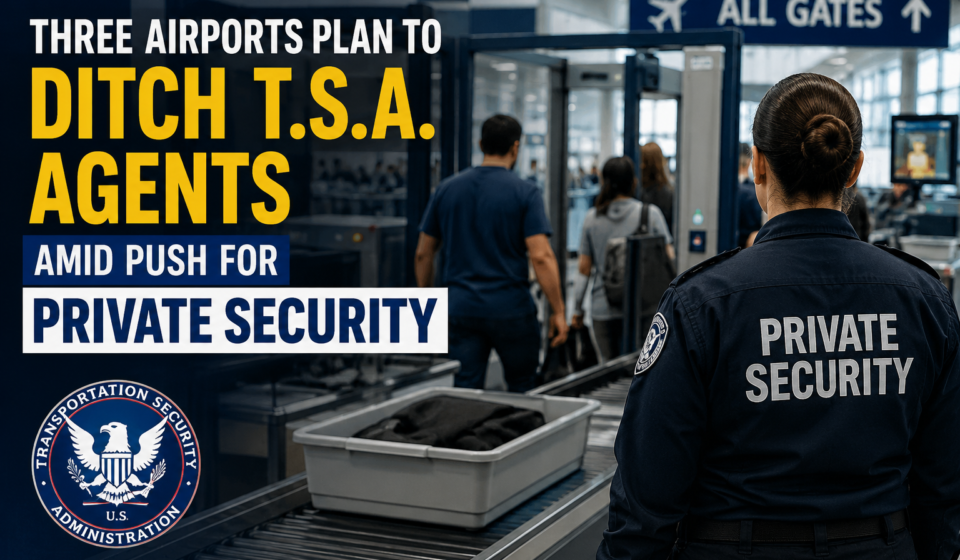

The debate over TSA private security is gaining renewed attention after three U.S. airports announced plans to replace Transportation Security Administration (TSA) officers with privately contracted security screeners under an existing federal program.
The move does not eliminate federal oversight. Instead, the airports aim to participate in the TSA’s Screening Partnership Program (SPP), which allows qualified private companies to conduct passenger and baggage screening while operating under TSA regulations and supervision.
Supporters argue the change could improve operational flexibility, reduce wait times, and enhance customer service. Critics, however, question whether privatizing airport screening would produce meaningful benefits over the current federally staffed system.
TSA Private Security Program Could Expand to More Airports
The airports seeking approval are pursuing entry into the TSA’s Screening Partnership Program, a long-standing initiative created after the September 11, 2001, terrorist attacks. While the majority of U.S. commercial airports continue to use federal TSA personnel, the SPP permits airports to contract screening services to private companies that meet strict federal requirements.
Under the program, private security officers perform the same screening duties as TSA employees. Their work includes passenger screening, baggage inspections, and security checkpoint operations. However, the TSA continues to establish security procedures, monitor compliance, conduct inspections, and maintain overall authority for aviation security.
Airport officials supporting the transition have cited operational efficiency as one of the primary reasons for seeking private contractors. Some believe private operators may be able to respond more quickly to staffing needs and implement management changes with greater flexibility than federal agencies.
Any airport wishing to join the program must receive formal approval from the TSA, which evaluates whether participation would maintain or improve security while benefiting airport operations.
Key Details and Reactions on TSA Private Security
The proposal has generated differing views across the aviation industry.
Airport administrators interested in the program say passengers are unlikely to notice significant differences in the screening process. Travelers would still comply with the same federal security rules, prohibited-items policies, and identification requirements because the TSA retains regulatory control.
Industry observers note that several airports already operate successfully under the Screening Partnership Program. Those facilities continue to follow identical federal screening standards despite employing private security personnel rather than federal TSA officers.
Labor groups representing TSA employees have historically expressed concerns that expanding private screening could affect workforce stability and reduce accountability. They argue that federal officers provide consistent national standards and public-sector oversight that should remain the foundation of aviation security.
Meanwhile, supporters of TSA private security contend that introducing competition among qualified contractors may encourage innovation, improve staffing efficiency, and enhance the passenger experience without compromising safety.
Background and Context of TSA Private Security
The Screening Partnership Program has existed for more than two decades as an alternative authorized under federal law. It was established following sweeping aviation security reforms enacted after the September 11 attacks.
Most U.S. airports remain staffed directly by the TSA, which was created in 2001 to federalize airport security screening. However, Congress also preserved the option for airports to request participation in the private screening program.
Currently, only a relatively small number of airports nationwide use private screening contractors through the SPP. These contractors must satisfy the same federal training, certification, and performance standards required by the TSA.
The distinction between the two systems is primarily administrative rather than operational. While staffing differs, security protocols, technology, passenger screening procedures, and federal oversight remain consistent regardless of whether screeners are federal employees or contractor personnel.
As air travel continues to recover and passenger volumes grow, airport operators have increasingly focused on improving checkpoint efficiency, reducing delays, and enhancing customer satisfaction. These priorities have contributed to renewed interest in alternative staffing models.
What Happens Next for TSA Private Security?
The airports’ requests will now move through the federal review process before any operational changes can occur.
The TSA will evaluate each application based on multiple factors, including security effectiveness, operational performance, cost considerations, and the airport’s ability to meet federal aviation security requirements.
If approved, the airports would begin selecting qualified private contractors to provide screening services. Those companies would remain subject to continuous TSA oversight, inspections, and performance evaluations.
Passengers should not expect immediate changes. The approval process can take months, and any transition would likely occur gradually to ensure continuity of security operations.
The broader policy discussion may also continue in Washington, where lawmakers and aviation stakeholders remain divided over whether expanding private screening should become a larger component of the nation’s airport security strategy.
For travelers, the most significant point is that airport security requirements—including identity verification, prohibited-item rules, and screening procedures—would remain governed by federal regulations regardless of who performs the screening.
Conclusion
The effort by three U.S. airports to pursue TSA private security highlights an ongoing debate over how airport screening should be managed while maintaining high security standards. Although the proposal would replace federal TSA officers with qualified private contractors at participating airports, the federal government would continue to oversee every aspect of aviation security. As the TSA reviews the applications, the outcome could influence future discussions about balancing operational efficiency, passenger experience, and national security across the U.S. aviation system.
- Joe Biden’s Cancer Has Spread Further, Hunter Biden Says
- Daylight Saving Time Explained: Why Clocks Change Every Year
- Trump Pushes for Daylight Saving Time as Clock Change Nears
- Spanish Enclave Ceuta Sees 60,000 Migrant Arrivals Within a Day
- FIFA Speeds Up 64-Team World Cup Plans Amid Gianni Infantino Sell-Off Proposal