
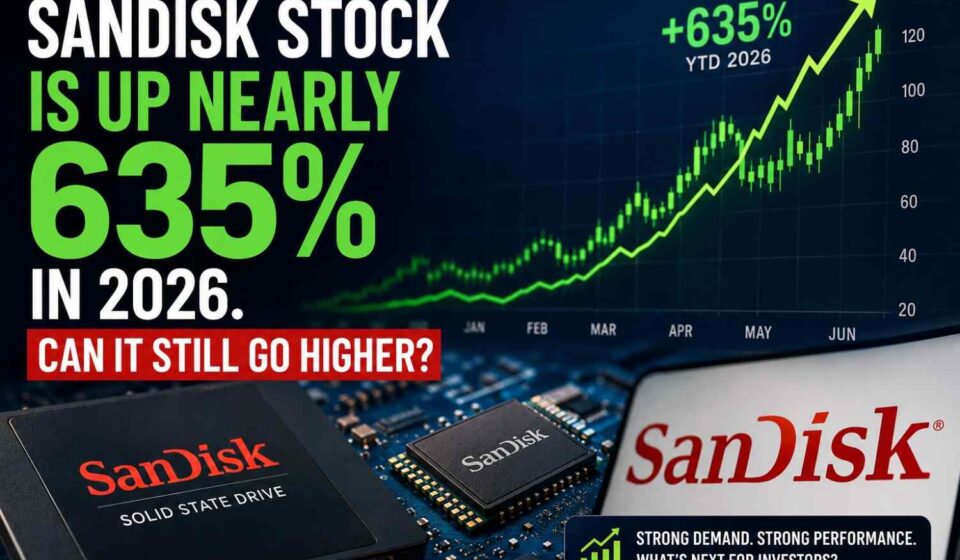

Sandisk Stock has become one of the standout performers in the technology sector during 2026, climbing nearly 635% and attracting the attention of both institutional and retail investors. The remarkable rally has raised an important question across financial markets: can the company continue its upward momentum, or has much of the optimism already been reflected in its valuation?
The surge comes amid improving conditions for the semiconductor and data storage industries, where stronger demand for flash memory, artificial intelligence infrastructure, and enterprise storage solutions has supported a broader recovery. While investors have welcomed the turnaround, analysts remain divided over whether additional gains are sustainable after such a rapid rise.
Sandisk Stock Rally Driven by Industry Recovery
The sharp rise in Sandisk Stock reflects a combination of company-specific developments and improving conditions across the semiconductor industry.
After several years of pricing pressure in the memory market, supply and demand have begun to rebalance. Manufacturers have reduced excess inventories, while cloud computing providers, enterprise customers, and AI-focused companies have increased spending on high-performance storage.
This recovery has improved expectations for revenue growth and profitability across the storage sector.
Investors have also become more optimistic about long-term demand for solid-state drives (SSDs), flash memory products, and enterprise storage systems. As businesses continue expanding AI workloads and data centers, demand for faster and more reliable storage solutions is expected to remain strong.
Market participants have interpreted these trends as positive indicators for Sandisk’s future earnings potential.
Why Sandisk Stock Could Continue Higher
Although a nearly 635% gain naturally raises concerns about valuation, several factors continue to support a positive outlook for Sandisk Stock.
First, global investment in artificial intelligence infrastructure continues to accelerate. AI applications require significant amounts of high-speed storage, benefiting companies that manufacture NAND flash memory and enterprise storage products.
Second, the cloud computing industry continues expanding capacity to support growing digital services. Large technology companies remain committed to increasing data center investments, creating long-term opportunities for storage hardware suppliers.
Third, improving pricing across the memory market has strengthened profit expectations. Analysts note that disciplined production among manufacturers has helped reduce oversupply, allowing prices to stabilize after previous declines.
However, these positive factors are balanced by higher expectations. Following such a significant rally, investors will likely expect continued earnings growth, making future quarterly results increasingly important.
Key Details and Reactions on Sandisk Stock
Market analysts have responded cautiously despite the impressive performance.
Some investment firms argue that improving industry fundamentals could justify additional upside if revenue growth continues to exceed expectations. Others believe the stock’s rapid appreciation leaves limited room for disappointment.
Investors are also monitoring management’s guidance closely. Future forecasts regarding enterprise demand, consumer electronics shipments, and flash memory pricing will likely influence the next phase of the stock’s performance.
Broader market conditions also remain an important consideration. Interest rate expectations, global economic growth, and technology sector sentiment could all affect investor appetite for semiconductor stocks.
For now, trading activity suggests that confidence remains strong, although volatility has increased as investors assess whether current valuations accurately reflect future growth.
Background and Context for Sandisk Stock
The storage industry has experienced significant cycles over the past decade.
Demand for NAND flash memory and SSDs has expanded steadily as businesses and consumers generate increasing amounts of digital data. At the same time, pricing has historically been highly cyclical, with periods of oversupply often leading to sharp declines in profitability.
The recent recovery follows an extended downturn in memory pricing that affected several semiconductor companies. As production discipline improved and inventories normalized, pricing conditions gradually strengthened.
Artificial intelligence has become an additional growth driver for the industry. AI servers require substantially more storage capacity than traditional computing systems, increasing demand for advanced storage technologies.
This structural shift has encouraged investors to reassess companies positioned to benefit from long-term data infrastructure investment.
What Happens Next for Sandisk Stock?
The next several quarters could determine whether Sandisk Stock can sustain its exceptional performance.
Investors will closely watch quarterly earnings reports for evidence that revenue growth and profit margins continue improving. Strong execution, expanding enterprise demand, and favorable memory pricing could support further gains.
Conversely, any slowdown in AI-related spending, renewed oversupply in the memory market, or weaker-than-expected consumer electronics demand could pressure the stock after its substantial rally.
Analysts also expect management commentary on production plans, capital investment, and long-term market demand to shape investor expectations.
While predicting future share prices remains difficult, many market observers agree that fundamentals will play a greater role than market momentum as valuations become more demanding.
Conclusion
Sandisk Stock has delivered one of the most remarkable performances in the technology sector during 2026, rising nearly 635% as the semiconductor industry benefits from improving memory pricing and growing AI-driven demand.
Whether the rally continues will largely depend on sustained earnings growth, healthy industry conditions, and the company’s ability to capitalize on expanding demand for enterprise storage solutions. While optimism remains high, investors are increasingly focused on execution and valuation as the next phase of the company’s growth story unfolds.
- Joe Biden’s Cancer Has Spread Further, Hunter Biden Says
- Daylight Saving Time Explained: Why Clocks Change Every Year
- Trump Pushes for Daylight Saving Time as Clock Change Nears
- Spanish Enclave Ceuta Sees 60,000 Migrant Arrivals Within a Day
- FIFA Speeds Up 64-Team World Cup Plans Amid Gianni Infantino Sell-Off Proposal