
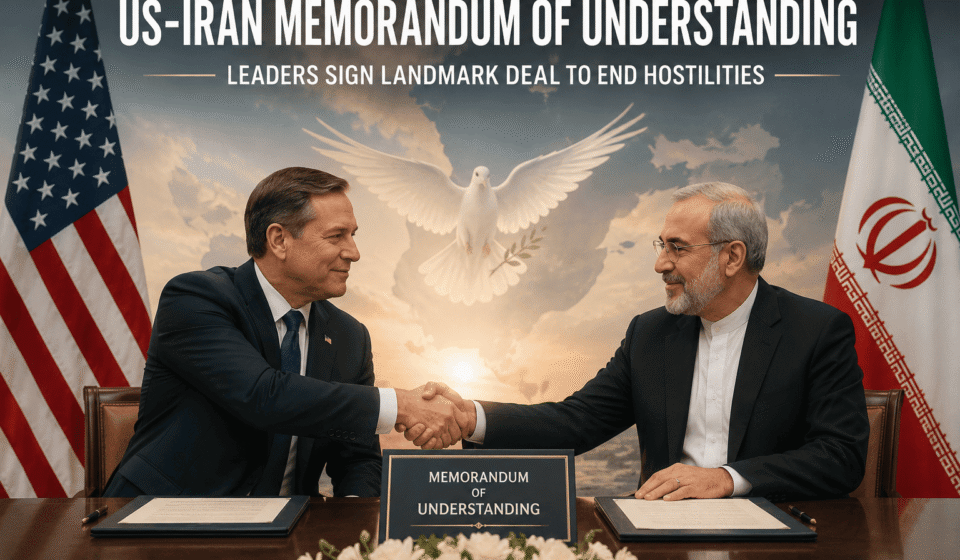
US-Iran Memorandum of Understanding: Full 14 Points of Landmark Deal Revealed

ISLAMABAD — In a historic diplomatic breakthrough, the United States and the Islamic Republic of Iran have formally signed a comprehensive framework agreement to bring an immediate end to the military conflict in West Asia. Known officially as the Islamabad US-Iran memorandum of understanding, the document establishes a permanent cessation of military operations across all active fronts, reopens critical global shipping lanes, and initiates a strict 60-day timeline for comprehensive nuclear and economic negotiations.
The agreement was finalized through remote digital signatures by U.S. President Donald Trump and Iranian President Masoud Pezeshkian. President Trump signed the document in France during a diplomatic dinner with French President Emmanuel Macron following the G7 summit, while President Pezeshkian concurrently affixed his signature in Tehran. Brokered primarily by Pakistan, the accord also received extensive mediation support from Qatar, Saudi Arabia, Turkey, and Egypt.
The implementation of the agreement marks the conclusion of nearly four months of intense, direct kinetic warfare between the two nations and their regional allies. By establishing an immediate ceasefire, the temporary framework aims to de-escalate a worsening global security crisis while setting up a structured, highly monitored channel for direct bilateral talks.
Main Development: The Official 14 Points of the Agreement
The text of the newly enacted US-Iran memorandum of understanding lays out a highly structured roadmap to transition the region from active conflict to diplomatic stabilization. The legally binding framework comprises the following 14 core points:
- 1. Immediate Ceasefire: A total and permanent termination of all military operations on all fronts, explicitly extending the mandate to include active combat zones in Southern Lebanon.
- 2. Renunciation of Hostilities: Both signatories, alongside their respective regional coalitions, undertake a legal obligation not to initiate any further hostile military actions against one another.
- 3. Removal of Naval Blockade: The United States commits to completely dismantling its naval blockade of Iranian ports, with the withdrawal process slated for full completion within 30 days.
- 4. Reopening of the Strait of Hormuz: Iran pledges to utilize its best efforts to guarantee the safe, toll-free passage of all international commercial vessels through the critical Strait of Hormuz for an initial period of 60 days.
- 5. Nuclear De-escalation: Tehran agrees to immediately halt advanced enrichment activities and down-blend its existing stockpiles of highly enriched uranium on-site.
- 6. IAEA Verification: All nuclear concessions will be verified under the direct, continuous, and unhindered supervision of the United Nations’ International Atomic Energy Agency (IAEA).
- 7. Launch of Comprehensive Talks: The formal initiation of a 60-day window for intensive bilateral talks in Switzerland to convert this temporary framework into a permanent, legally binding peace treaty.
- 8. Energy Export Waivers: The U.S. Department of the Treasury will issue immediate financial waivers allowing the verified export of Iranian crude oil, petroleum products, and associated banking transactions.
- 9. Asset Unfreezing: A structured timeline will be established to gradually unfreeze restricted Iranian foreign assets held in international banks, contingent upon verified compliance.
- 10. Regional Reconstruction Fund: The United States agrees to cooperate with regional partners to engineer a $300 billion reconstruction and economic development plan for conflict-affected zones.
- 11. Prisoner Exchange Framework: Both nations agree to establish a humanitarian committee to facilitate the immediate registration and eventual swap of detained citizens and prisoners of war.
- 12. Deployment of Observers: Joint monitoring teams, composed of representatives from mediating nations (Pakistan, Qatar, and Egypt), will deploy to key maritime and land corridors to log compliance.
- 13. Foreign Military Pullback: The framework outlines a phased withdrawal of Western naval reinforcements from the proximity of Iranian waters, scheduled for 30 days after a final treaty is ratified.
- 14. Enforcement Mechanisms: The document explicitly states that any verifiable failure by either signatory to adhere to these 14 points will result in the immediate nullification of waivers and a resumption of defensive military operations.
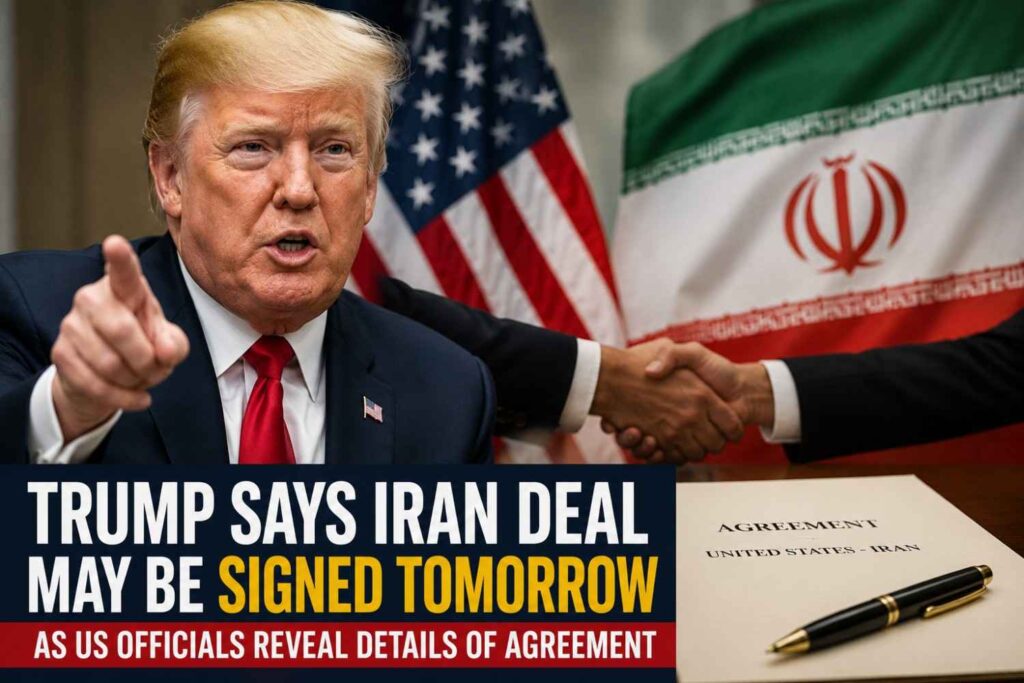
Key Details and Reactions from Global Leadership
The publication of these specific points has drawn sharp reactions across the international community, highlighting both optimism for regional stability and intense skepticism regarding compliance. In a public statement following the signing, President Trump emphasized that while the memorandum stops the active conflict, the U.S. military posture remains vigilant. He warned reporters that any verifiable failure by Tehran to adhere to the framework would result in an immediate resumption of defensive military strikes.
“We have a framework, but they must behave,” Trump stated. “If the commitments are broken, the alternative remains an immediate return to our enforcement operations.”
From Tehran, Iranian government spokespersons framed the document as a recognition of regional realities, asserting that the removal of Western naval forces from the proximity of Iranian waters is a significant sovereign achievement. However, international defense analysts have noted that Israel is not a formal signatory to the document. Consequently, uncertainty persists regarding how the terms will affect independent security operations targeting regional proxy networks in southern Lebanon.
Background and Context of the Confrontation
The conflict, which erupted rapidly earlier this year, followed a period of intense geopolitical pressure and a breakdown in back-channel diplomatic communications. The implementation of a total naval blockade by Western forces and subsequent retaliatory mine-laying and ship seizures in the Persian Gulf had severely choked international trade, driving global oil prices to volatile heights.
The newly signed US-Iran memorandum of understanding acts as a structural bridge to resolve deep-seated grievances that outlived the 2015 Joint Comprehensive Plan of Action (JCPOA). Unlike previous iterations, this 14-point framework tightly intertwines massive economic incentives with verified defense concessions. By linking immediate sanctions relief directly to maritime safety and IAEA access, mediators have attempted to create a self-enforcing mechanism that addresses the core security anxieties of both Washington and Tehran.
What Happens Next?
With the temporary framework now legally active, diplomatic delegations from the United States, Iran, Pakistan, and Qatar are converging on the Bürgenstock Resort near Lucerne, Switzerland, to commence the initial implementation talks dictated by Point 7. The two primary factions have exactly 60 days to convert this preliminary memorandum into a permanent peace treaty.
Over this two-month window, the immediate focus will be on the smooth rollout of oil export waivers and the stabilization of commercial shipping lines. Meanwhile, global markets have already reacted sharply to the publication of the 14 points, with Brent crude and West Texas Intermediate futures both dropping over 1% as shipping lanes prepare to normalize under international observation.
Conclusion
The signing of the US-Iran memorandum of understanding introduces a vital, though fragile, pause to active military hostilities in West Asia. While the reopening of the Strait of Hormuz and the introduction of energy export waivers provide immediate relief to the global economy, the true success of the Islamabad MoU hinges on the upcoming 60 days of intense negotiations in Switzerland. Whether this 14-point framework matures into a durable peace treaty or dissolves back into conflict depends entirely on verified compliance and the resolution of deeply entrenched nuclear disputes.
- Joe Biden’s Cancer Has Spread Further, Hunter Biden Says
- Daylight Saving Time Explained: Why Clocks Change Every Year
- Trump Pushes for Daylight Saving Time as Clock Change Nears
- Spanish Enclave Ceuta Sees 60,000 Migrant Arrivals Within a Day
- FIFA Speeds Up 64-Team World Cup Plans Amid Gianni Infantino Sell-Off Proposal