
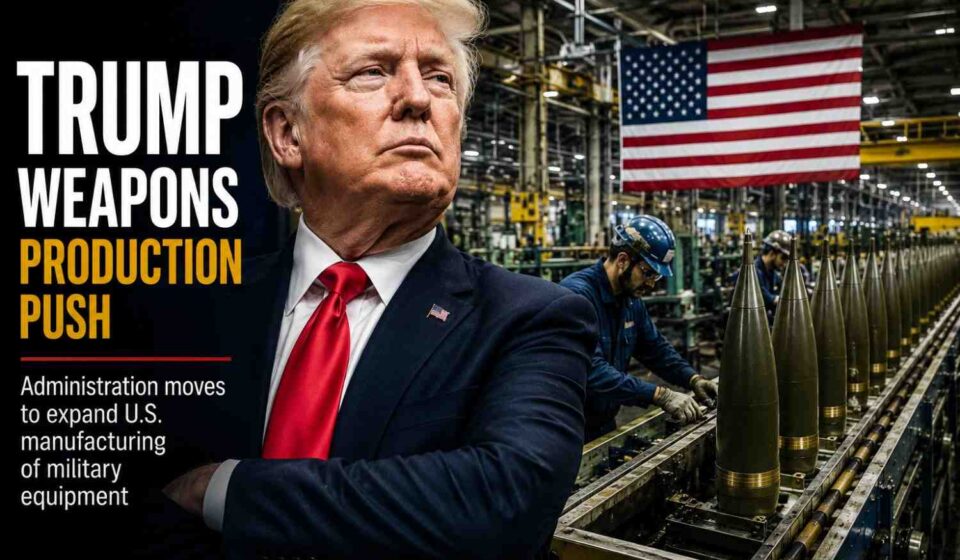

The Trump weapons production push is reshaping the American defense industry as the administration moves to increase domestic manufacturing of munitions, missiles, and other military equipment.
President Donald Trump has recently taken a series of steps aimed at accelerating weapons production, citing concerns about supply chain vulnerabilities, production bottlenecks, and the need to maintain military readiness. The effort comes as the Pentagon faces growing demand for critical weapons systems and seeks to replenish stockpiles used to support U.S. military operations and allied security commitments.
The initiative represents one of the most significant attempts in recent years to expand the U.S. defense industrial base and involve a broader range of American manufacturers in military production.
Main Development: Trump Weapons Production Push Gains Momentum
The latest phase of the Trump weapons production push centers on the administration’s decision to invoke the Defense Production Act (DPA), a federal law that allows the government to work directly with private industry when national defense requirements are at risk.
In a memorandum issued to the Department of Defense, Trump cited concerns about limited manufacturing capacity, fragile supply chains, and long-term production constraints affecting critical weapons components. The administration identified solid rocket motors, guidance systems, and igniters among the most important areas requiring additional industrial capacity.
The Defense Production Act gives federal authorities greater flexibility to coordinate with private companies and establish agreements designed to strengthen defense manufacturing capabilities. Administration officials argue that these measures are necessary to ensure the United States can meet future military requirements without facing shortages or production delays.
The White House has also promoted broader initiatives designed to increase domestic weapons manufacturing, including policies focused on reindustrialization, expanding defense exports, and strengthening production capacity across the defense sector.
Key Details and Reactions to the Trump Weapons Production Push
Defense manufacturers have responded by announcing new partnerships and production expansion plans.
One of the most notable developments involves collaboration between major defense contractor Lockheed Martin and automotive giant General Motors. The companies said they would work together to support defense manufacturing efforts, focusing on production readiness, supply chain resilience, and manufacturing efficiency.
The partnership reflects a broader Pentagon strategy of bringing non-traditional manufacturers into defense production. Officials believe large industrial companies possess expertise that can help accelerate manufacturing and reduce production bottlenecks.
Earlier this year, Trump also stated that several leading defense contractors had agreed to significantly increase production of advanced weapons systems. Companies participating in discussions reportedly included Boeing, Lockheed Martin, Northrop Grumman, Raytheon, L3Harris, Honeywell Aerospace, and BAE Systems.
Supporters of the initiative argue that expanding domestic manufacturing capacity will improve national security and reduce reliance on fragile supply chains. Critics, however, have questioned whether production targets can be achieved quickly given the complexity of modern weapons systems and the time required to expand facilities and train workers.
Background and Context
The current effort builds on a broader push to modernize the U.S. defense industrial base.
For years, defense officials and lawmakers have warned that America’s military manufacturing capacity has struggled to keep pace with rising geopolitical challenges. Concerns have intensified due to increased demand for missiles, air defense systems, artillery ammunition, and other military equipment.
The Trump administration has pursued several initiatives designed to increase production and accountability within the defense sector. These measures include reforms to foreign military sales, efforts to streamline procurement processes, and policies intended to prioritize manufacturing investments over shareholder payouts among major defense contractors.
In February, the White House announced the “America First Arms Transfer Strategy,” which aims to align defense exports with domestic manufacturing goals while strengthening critical supply chains and supporting industrial expansion.
The administration argues that expanding production capacity will help ensure the United States remains capable of supplying both its own military and allied nations with advanced defense systems.
What Happens Next?
The future success of the initiative will depend largely on funding, industrial investment, and implementation.
Defense companies are expected to continue investing in new facilities, production lines, and supply chain improvements. Some manufacturers have already announced multi-billion-dollar expansion plans designed to increase output over the coming years.
At the same time, Congress will play an important role in determining the pace of expansion through defense spending legislation and appropriations. Additional funding requests aimed at replenishing military stockpiles and supporting industrial growth are likely to receive significant attention in Washington.
Industry experts note that while production increases are achievable, major expansions often require several years before reaching full capacity. As a result, the impact of today’s decisions may continue to shape U.S. defense capabilities well into the next decade.
Conclusion
The Trump weapons production push marks a major effort to strengthen America’s defense manufacturing base amid rising demand for military equipment and concerns about supply chain resilience. By invoking the Defense Production Act, encouraging industry partnerships, and promoting expanded industrial capacity, the administration is seeking to accelerate weapons production and improve military readiness. Whether these initiatives deliver the desired results will depend on long-term investment, congressional support, and the ability of manufacturers to scale production efficiently in the years ahead.
- Joe Biden’s Cancer Has Spread Further, Hunter Biden Says
- Daylight Saving Time Explained: Why Clocks Change Every Year
- Trump Pushes for Daylight Saving Time as Clock Change Nears
- Spanish Enclave Ceuta Sees 60,000 Migrant Arrivals Within a Day
- FIFA Speeds Up 64-Team World Cup Plans Amid Gianni Infantino Sell-Off Proposal