
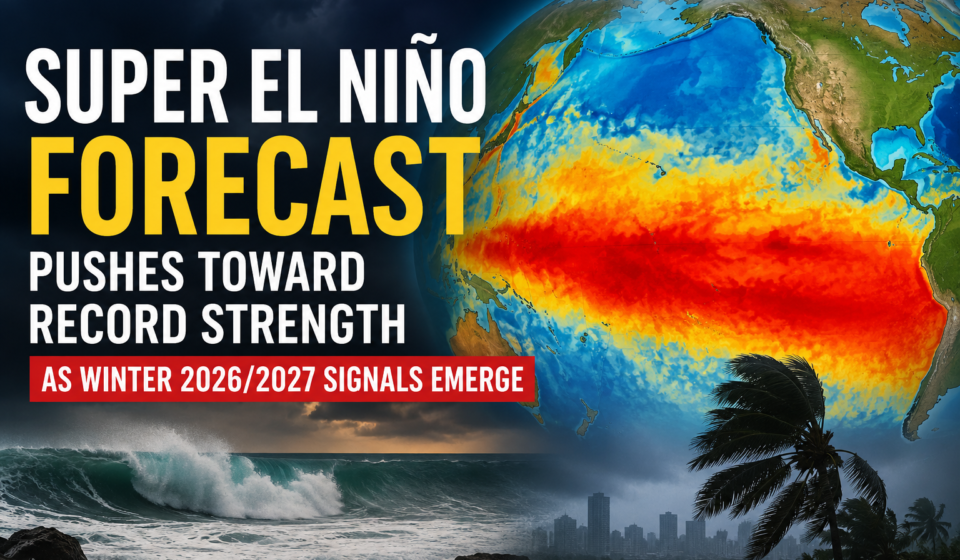
Super El Niño Forecast Pushes Toward Record Strength as Winter 2026/2027 Signals Emerge

A Super El Niño Forecast indicating the possibility of one of the strongest warming events on record is drawing increasing attention from climate scientists as early indicators begin to emerge ahead of the 2026/2027 winter season. While researchers caution that seasonal outlooks remain subject to change, several forecasting models suggest that ocean and atmospheric conditions in the tropical Pacific could evolve into an unusually powerful El Niño event.
Scientists emphasize that forecasts this far in advance carry uncertainty. However, continued warming of sea surface temperatures and evolving atmospheric patterns are strengthening confidence that the Pacific Ocean could enter a significant El Niño phase if current trends continue.
The development is being closely monitored because strong El Niño events have historically influenced weather conditions across multiple continents, affecting rainfall, drought, tropical cyclone activity, agriculture, water resources, and global temperatures.
Main Development: Super El Niño Forecast Gains Scientific Attention
The latest Super El Niño Forecast is based on observations of above-average sea surface temperatures across the central and eastern equatorial Pacific Ocean. Climate models also indicate weakening trade winds, a key atmospheric feature that often accompanies the onset and strengthening of El Niño conditions.
Meteorologists describe a “Super El Niño” as an exceptionally strong El Niño event, typically characterized by sustained ocean temperature anomalies significantly above average. Only a handful of such events have been recorded in the modern observational era, including those of 1982-83, 1997-98, and 2015-16.
Should the developing pattern continue, the 2026/2027 event could rank among the strongest ever observed. Nevertheless, researchers stress that forecasts remain probabilistic rather than definitive, and ocean-atmosphere interactions over the coming months will determine the eventual strength of the event.
Climate agencies worldwide continue updating their seasonal outlooks as additional satellite observations, ocean buoy measurements, and atmospheric data become available.
Key Details and Reactions to the Super El Niño Forecast
Scientists caution against interpreting the forecast as a guarantee of specific local weather outcomes. El Niño influences global weather patterns, but regional impacts depend on many interacting climate systems.
In North America, stronger El Niño conditions often bring wetter-than-average winters across the southern United States while increasing the likelihood of milder conditions in parts of Canada and the northern U.S. However, each event develops differently.
Australia and parts of Southeast Asia frequently experience reduced rainfall and elevated wildfire risks during major El Niño episodes. Meanwhile, portions of western South America can receive significantly above-average rainfall, increasing flood concerns.
Agricultural experts are also watching developments closely because changes in seasonal rainfall and temperatures can affect crop production, food prices, and water availability across several major farming regions.
Energy markets may also monitor the forecast, as prolonged heat or unusual winter conditions can influence electricity demand, hydropower generation, and natural gas consumption in different parts of the world.
Background and Context: Understanding the Super El Niño Forecast
El Niño forms when sea surface temperatures in the tropical Pacific become significantly warmer than normal, disrupting global atmospheric circulation. It represents one phase of the El Niño-Southern Oscillation (ENSO), a naturally occurring climate pattern that alternates between El Niño, La Niña, and neutral conditions.
Although ENSO is a natural climate cycle, scientists continue studying how rising global temperatures may influence the frequency, intensity, and impacts of extreme El Niño events.
Historically, strong El Niño episodes have been associated with record global temperatures because ocean heat is transferred into the atmosphere. This combination can amplify heatwaves in some regions while increasing heavy rainfall and flooding in others.
The 1997-98 Super El Niño caused widespread flooding in parts of the Americas while contributing to severe drought and wildfires across Indonesia and Australia. The 2015-16 event similarly produced significant weather disruptions and contributed to then-record global temperatures.
Modern forecasting capabilities have improved substantially through advanced climate models, satellites, ocean-monitoring systems, and international collaboration, allowing scientists to identify developing patterns months before peak conditions occur.
What Happens Next for the Super El Niño Forecast?
Researchers will continue tracking sea surface temperatures, subsurface ocean heat content, atmospheric pressure patterns, and trade wind behavior over the coming months.
National meteorological agencies and international climate centers are expected to issue updated seasonal forecasts regularly as confidence in the developing pattern changes.
Governments, emergency management agencies, agricultural organizations, and water resource planners will also monitor the outlook to prepare for potential weather-related impacts. Early planning can help reduce risks associated with flooding, drought, wildfire activity, and agricultural disruption should the event strengthen further.
Scientists note that forecast confidence generally improves as the anticipated event approaches. Until then, updated observations and model guidance will determine whether the projected warming ultimately reaches Super El Niño intensity or stabilizes at a lower level.
Conclusion
The emerging Super El Niño Forecast has become an important focus for climate scientists as early signals point toward a potentially powerful warming event ahead of the 2026/2027 winter. Although uncertainties remain, current climate models indicate that Pacific Ocean conditions warrant close monitoring.
If the forecast continues to strengthen, the event could influence weather patterns across multiple continents, affecting agriculture, water resources, energy demand, and disaster preparedness. Updated seasonal outlooks in the coming months will provide greater clarity on whether the developing El Niño reaches record strength and what its global consequences may be.
- Joe Biden’s Cancer Has Spread Further, Hunter Biden Says
- Daylight Saving Time Explained: Why Clocks Change Every Year
- Trump Pushes for Daylight Saving Time as Clock Change Nears
- Spanish Enclave Ceuta Sees 60,000 Migrant Arrivals Within a Day
- FIFA Speeds Up 64-Team World Cup Plans Amid Gianni Infantino Sell-Off Proposal