
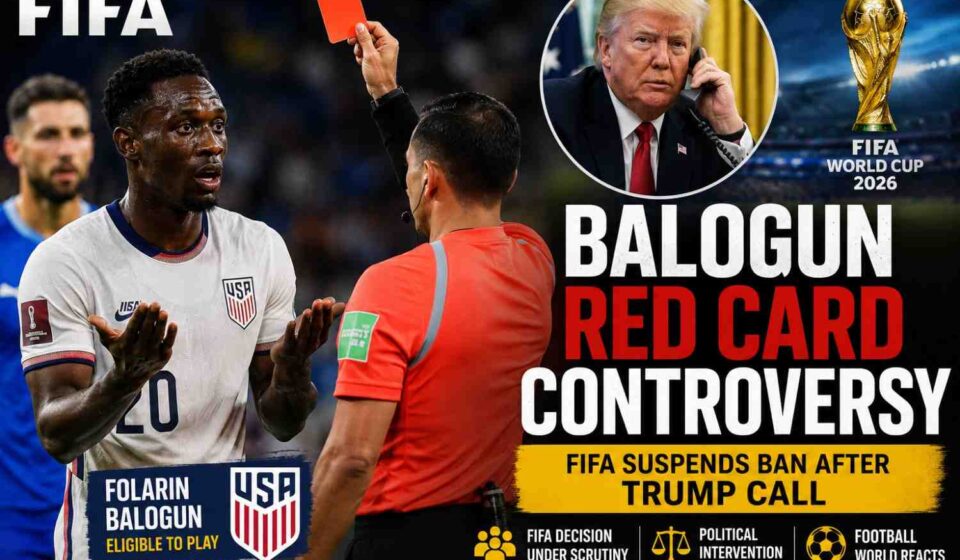

The Balogun red card controversy has become one of the defining talking points of the 2026 FIFA World Cup after FIFA suspended the implementation of United States striker Folarin Balogun’s automatic one-match ban following reports of intervention by U.S. President Donald Trump. The decision has prompted criticism from football officials, national associations and commentators, raising broader questions about the integrity of the tournament and FIFA’s disciplinary process.
Balogun was shown a straight red card during the United States’ Round of 32 victory over Bosnia and Herzegovina after a VAR review. Under FIFA regulations, a direct red card typically results in an automatic suspension for the following match. However, FIFA later announced that it had suspended the implementation of the sanction under Article 27 of its Disciplinary Code, allowing Balogun to remain eligible for the United States’ Round of 16 match against Belgium.
The move has generated an international debate that extends beyond a single disciplinary decision.
Balogun Red Card Controversy Centers on FIFA’s Decision
The Balogun red card controversy is not primarily about whether the original dismissal was correct. Many players, coaches and analysts considered the challenge harsh enough to debate, while others believed a yellow card would have been sufficient.
Instead, the controversy stems from FIFA’s decision to suspend the automatic ban rather than overturn the red card itself.
FIFA relied on Article 27 of its Disciplinary Code, which permits judicial bodies to suspend the implementation of certain sanctions under specific circumstances. The governing body placed Balogun on a one-year probationary period, meaning the suspension could still take effect if he commits a similar offence during that time.
Critics argue that this approach creates uncertainty because FIFA did not invalidate the referee’s decision but still allowed the player to participate in the next World Cup match.
Balogun Red Card Controversy Sparks International Reaction
Reaction from across football has been swift.
UEFA described FIFA’s action as crossing “a red line,” arguing that automatic suspensions following red cards are fundamental to maintaining consistency and competitive integrity. Belgium’s football federation also criticized the decision, saying it was reviewing its options while emphasizing the importance of equal treatment for every participating nation.
Former FIFA president Sepp Blatter questioned whether political intervention should ever influence disciplinary decisions, while several national team coaches expressed concern that the move could establish a precedent for future tournaments.
Reports from Reuters, CBS News and other outlets stated that President Donald Trump spoke with FIFA President Gianni Infantino before the governing body announced its decision. FIFA has not publicly stated that the phone call determined the outcome, but the reported sequence of events has intensified scrutiny of the organization’s independence.
Background and Context
The incident began when Balogun was dismissed after VAR reviewed a challenge on Bosnia and Herzegovina defender Tarik Muharemovic during the United States’ knockout-stage victory.
Under normal FIFA World Cup regulations, players receiving a straight red card serve an automatic one-match suspension. Such sanctions have historically been applied consistently throughout the tournament.
FIFA’s decision to suspend the implementation of Balogun’s ban, rather than rescind the red card itself, has therefore attracted unusual attention.
Supporters of the decision argue that Article 27 exists precisely to address exceptional situations and that FIFA acted within its disciplinary framework. Critics counter that applying the provision during the World Cup without providing detailed reasoning risks undermining confidence in the consistency of tournament governance.
The controversy has also renewed discussion about FIFA’s relationship with host nations and the importance of insulating sporting decisions from perceived political influence.
What Happens Next?
Balogun is now available to represent the United States in its Round of 16 match against Belgium following FIFA’s decision.
Attention is likely to remain focused on whether FIFA provides a fuller explanation of how Article 27 was applied in this case and whether similar requests could arise during future tournaments.
Football governing bodies, national associations and legal experts are also expected to examine whether clearer guidance is needed regarding discretionary disciplinary powers, particularly during major international competitions.
Regardless of the outcome of the United States’ World Cup campaign, the debate surrounding FIFA’s handling of Balogun’s suspension is expected to continue long after the tournament concludes.
Conclusion
The Balogun red card controversy has evolved into a broader discussion about football governance, disciplinary consistency and the perception of political influence in sport. While FIFA maintains that its decision was made under the provisions of its disciplinary rules, critics argue that the move has created uncertainty about how those rules will be applied in future cases.
As the World Cup progresses, the controversy is likely to remain one of the tournament’s most closely watched off-field developments, with governing bodies and supporters alike looking for greater clarity over FIFA’s disciplinary processes.
- Joe Biden’s Cancer Has Spread Further, Hunter Biden Says
- Daylight Saving Time Explained: Why Clocks Change Every Year
- Trump Pushes for Daylight Saving Time as Clock Change Nears
- Spanish Enclave Ceuta Sees 60,000 Migrant Arrivals Within a Day
- FIFA Speeds Up 64-Team World Cup Plans Amid Gianni Infantino Sell-Off Proposal