
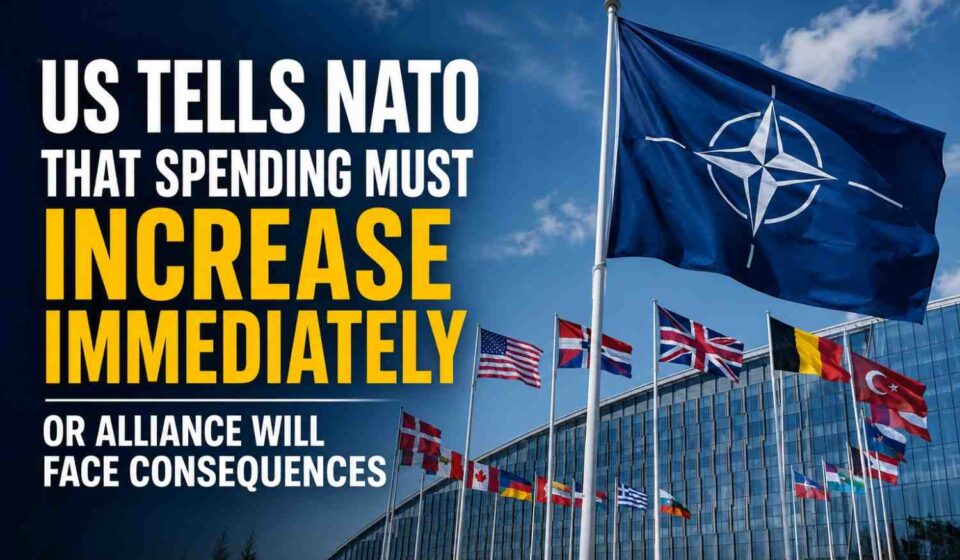
US tells NATO that spending must increase ‘immediately’ or alliance will face consequences

The United States has intensified its demand for higher NATO defense spending, warning alliance members that they must significantly increase military budgets without delay or face consequences for the future of the transatlantic alliance.
The message comes as NATO leaders continue to confront growing security challenges across Europe, including the ongoing war in Ukraine, increased military activity by Russia, and broader concerns about long-term defense readiness. Washington has argued that stronger financial commitments from European allies are essential to maintaining the alliance’s collective security.
The renewed pressure reflects a long-running debate over burden-sharing within NATO, where the United States has consistently contributed the largest share of military spending.
NATO Defense Spending at the Center of US Warning
US officials stressed that NATO defense spending must rise immediately rather than through gradual long-term commitments. The warning signals increasing frustration in Washington over allies that continue to spend below agreed defense targets.
NATO members previously committed to spending at least 2% of their gross domestic product (GDP) on defense. However, recent discussions within the alliance have shifted toward even higher targets as security threats have intensified.
US representatives argued that today’s strategic environment requires greater military investment than ever before. They emphasized that stronger defense budgets are needed to improve military readiness, modernize equipment, expand ammunition production, and strengthen deterrence capabilities across Europe.
The comments also come amid broader efforts by NATO to reinforce its eastern flank and increase support for Ukraine as the conflict with Russia continues.
Key Details and Reactions on NATO Defense Spending
Several NATO governments have already announced plans to increase defense budgets over the coming years. Countries that were previously below the alliance’s spending benchmark have accelerated investment programs following Russia’s full-scale invasion of Ukraine in 2022.
NATO Secretary General Mark Rutte has repeatedly emphasized that higher defense investment is necessary to maintain the alliance’s credibility and ensure collective defense commitments remain effective.
Many European leaders acknowledge that security conditions have changed significantly over the past several years. While governments generally agree on the need for increased military spending, implementation timelines differ depending on national budgets, political priorities, and economic conditions.
Some governments have highlighted the financial pressures created by inflation, rising public debt, and domestic spending demands. Nevertheless, defense has increasingly become a higher budget priority across much of Europe.
Defense analysts say the US warning is intended to accelerate political decisions rather than introduce a new policy. Washington has consistently argued that all allies should contribute more equally to NATO’s collective defense.
Background and Context of NATO Defense Spending
The debate over NATO defense spending has existed for more than a decade but has gained renewed urgency since Russia’s invasion of Ukraine.
NATO established the 2% GDP defense spending guideline to encourage fair burden-sharing among its members. While several countries initially struggled to reach that benchmark, defense expenditures have risen steadily across the alliance in recent years.
The United States remains NATO’s largest military contributor, providing extensive funding, advanced capabilities, intelligence support, and strategic assets. Successive US administrations—regardless of political affiliation—have called on European allies to increase their own military investments.
In response to evolving security challenges, NATO has expanded troop deployments along its eastern borders, strengthened air defense systems, increased multinational military exercises, and accelerated procurement of modern weapons systems.
Security experts note that military spending is no longer viewed solely as a response to Russia. Growing concerns about cyber threats, emerging technologies, hybrid warfare, and global strategic competition have also shaped defense planning across the alliance.
As NATO prepares for future summits and long-term defense planning, funding commitments remain one of the most closely watched issues among member states.
What Happens Next for NATO Defense Spending?
Alliance members are expected to continue negotiations over future defense investment targets and implementation schedules during upcoming NATO meetings.
Several governments are preparing new defense spending plans that could exceed the traditional 2% benchmark, reflecting changing security realities across Europe. Discussions are also likely to focus on improving industrial defense production, strengthening military logistics, and increasing cooperation among allied armed forces.
The United States is expected to maintain pressure for faster action, arguing that immediate investment is necessary to ensure NATO remains capable of responding to current and future threats.
Observers will also closely watch whether additional funding commitments translate into measurable improvements in military readiness, equipment modernization, and collective deterrence.
The broader debate over defense spending is likely to remain central to NATO’s agenda as the alliance adapts to an increasingly uncertain global security environment.
Conclusion
The latest US warning underscores the growing importance of NATO defense spending as the alliance faces a rapidly changing security landscape. While many member states have already increased military budgets, Washington is calling for faster and more substantial action to strengthen collective defense. As NATO continues to respond to evolving geopolitical challenges, defense investment is expected to remain one of the alliance’s highest strategic priorities.
- Joe Biden’s Cancer Has Spread Further, Hunter Biden Says
- Daylight Saving Time Explained: Why Clocks Change Every Year
- Trump Pushes for Daylight Saving Time as Clock Change Nears
- Spanish Enclave Ceuta Sees 60,000 Migrant Arrivals Within a Day
- FIFA Speeds Up 64-Team World Cup Plans Amid Gianni Infantino Sell-Off Proposal